
TL;DR: Three forces are reshaping retail in 2026 — AI-driven personalisation and automation, value-seeking consumer behaviour, and experience-led physical retail. Retailers that treat these as separate trends will struggle. The ones pulling ahead are those building the operational infrastructure to connect all three, at scale.
Retail has always been a moving target. But right now, something different is happening. The pace of change is faster and the nature of the change is more structural. Consumer expectations have shifted in ways that don't reverse. Technology has crossed a threshold from "pilot project" to "operating system." And the pressure on margin hasn't eased — it's sharpened.
Three forces are doing most of the heavy lifting in 2026. Artificial intelligence, which has moved firmly from experimentation into execution. Value, which has become a structural consumer mindset rather than a recessionary blip. And experience, which is redefining what a physical store actually has to offer. None of these are new headlines. What is new is the way they're converging and what that convergence demands from the operations teams running retail day to day.
This blog maps out all three, how they connect, and what it means for the infrastructure behind the store floor.
How is AI actually being used in retail right now?
A year ago, a lot of retail AI conversations were still theoretical. Now they're operational. The shift from experimentation to execution is the defining characteristic of AI in retail in 2026 and it's showing up across four areas in particular.
Agentic AI is the one generating the most noise, and rightly so. Rather than passively answering queries, agentic AI systems complete multi-step tasks autonomously: reordering stock, updating pricing, flagging supply chain exceptions — all without waiting to be prompted. According to McKinsey, AI-enabled supply chain management has the potential to reduce forecasting errors by up to 50% and cut lost sales linked to stock-outs by up to 65%. Those aren't marginal gains.
Conversational commerce is moving beyond chatbots. AI-powered shopping assistants are now embedded in retail apps and websites, guiding purchasing decisions in real time, handling returns, and personalising product recommendations based on live data. Deloitte notes that retailers deploying conversational AI in customer-facing functions are seeing measurable improvements in conversion rates and basket size.
AI-driven personalisation at scale is what separates the leaders from the laggards. Retailers like Zara and H&M have been investing heavily in AI to match inventory to demand signals at a hyper-local level not just by region, but by individual store. The result is less markdowns, less waste, and higher sell-through rates.
Supply chain optimisation is where the operational impact is perhaps most tangible. AI models processing real-time data — foot traffic, weather, local events, supplier lead times — are enabling retailers to move from reactive ordering to predictive replenishment. That shift alone changes the economics of multi-store operations significantly.
Why is value-seeking consumer behaviour a structural trend, not a temporary one?
The cost-of-living squeeze triggered a fundamental reset in how consumers relate to price. What's significant about 2026 is that even as some economic pressure has eased, the behaviours it created haven't reversed. Shoppers who discovered private-label products during tighter times have largely stuck with them. Trading down — across grocery, fashion, and homewares — has become a preference, not just a necessity.
According to NRF's 2026 retail outlook, value remains the number one purchase driver across most consumer categories. Loyalty programmes have gained renewed traction, but only when they deliver genuine, tangible rewards rather than points that feel abstract. Retailers that have responded by deepening their private-label ranges and sharpening their price architecture are seeing the results in both volume and margin.
The implication for operations is significant. Margin discipline is no longer just a finance conversation; it's an operations one. Every process that generates waste, every stockout that forces an emergency order, every excess delivery that adds cost without adding value: these are margin problems as much as they are operational ones. Retailers that get this understand that operational efficiency and commercial performance are the same thing.
What does experience-led retail look like in 2026?
The physical store has had a complicated few years. Predictions of its decline were exaggerated, but the version of the store that survives in 2026 looks quite different from the one that struggled during the pandemic years.
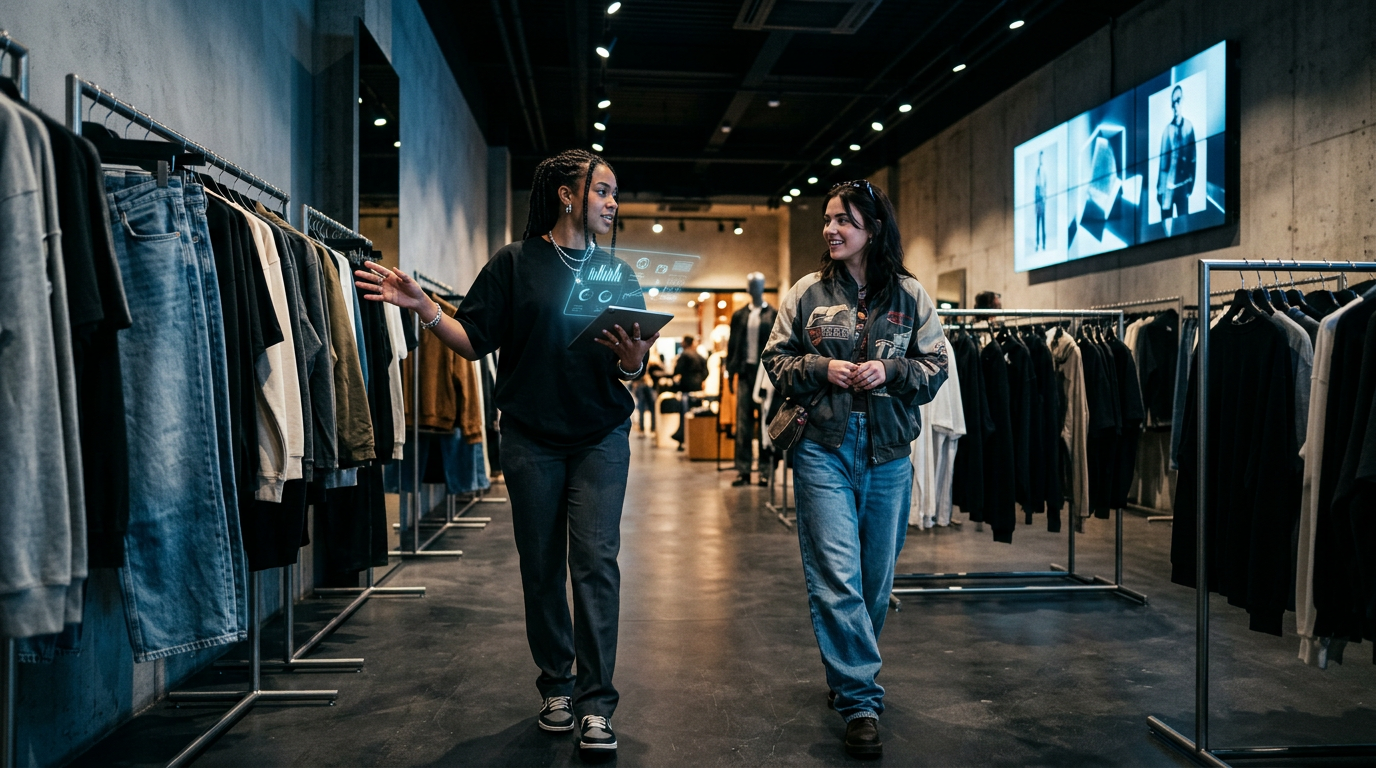
What's working is experience. Stores designed around discovery, community, and engagement rather than pure transaction. VML's NRF 2026 report highlighted immersive retail formats as one of the most significant growth areas, with brands investing in AR-enabled fitting rooms, in-store events, and connected store environments that bridge the digital and physical experience.
AR and VR are no longer novelty features. Retailers including IKEA, Nike, and Sephora have integrated augmented reality into both their apps and their physical environments, allowing customers to visualise products in context before purchasing. The data from these interactions feeds directly back into inventory and merchandising decisions.
Retail media has also become a meaningful part of the in-store experience equation. Digital screens, personalised offers triggered by loyalty app data, and in-store advertising partnerships are generating new revenue streams while deepening customer engagement. According to McKinsey, retail media is projected to become a $100 billion global industry by 2026, with much of that growth driven by in-store formats.
Connected stores — where inventory, customer behaviour, and staff operations are linked through real-time data systems — are moving from premium rollout to standard expectation. The operational complexity this creates is real, but so is the commercial upside.
Why do AI, value, and experience have to work together?
Here's the thing about treating AI, value, and experience as three separate strategic priorities: they don't work as well in isolation as they do together. AI is the connective tissue that makes value and experience scalable.
Without AI, delivering personalised experiences across hundreds of stores requires enormous manual effort and is inconsistent at best. With AI, a retailer can tailor the in-store offer — from product placement to promotions to staff deployment — based on real-time local signals, consistently and at speed.
Without AI, value delivery depends on manual margin management and reactive markdown decisions. With AI-powered demand forecasting, retailers can protect margin proactively, buying closer to need, replenishing more precisely, and reducing the clearance cycles that eat into profitability.
The retailers pulling ahead in 2026 aren't picking one of these three forces to focus on. They're building the systems — and the operational backbone — that let all three work together.
What operational infrastructure do retailers need to make this work?
This is where strategy meets reality. The AI tools, the immersive formats, the loyalty programmes — none of them deliver without the operational infrastructure to support them. And that infrastructure is more complex than it often gets credit for.
Unified commerce is the foundation. Retailers need inventory data, customer data, and transaction data connected across all channels — not siloed by format or geography. This is a data and systems challenge, but it's also a supplier and logistics challenge. Knowing what's in stock in real time requires supply chain partners who can provide the same visibility.
Operational consistency across stores becomes more critical, not less, as experience-led retail raises consumer expectations. If a customer has a great experience in one location, they expect it across all locations. That demands standardised operational processes, reliable GNFR supply, and the kind of inventory control that doesn't leave store teams firefighting stockouts during peak trading periods.
Reduced complexity in the back of house is what gives store teams the capacity to actually deliver experience. Every hour a store manager spends chasing a missing delivery or resolving a supply issue is an hour not spent on the customer. For multi-store retailers, the cumulative effect of operational friction across hundreds of locations is substantial in cost, in staff morale, and in customer experience.
This is exactly where GNFR management becomes a strategic conversation rather than a procurement one. When Goods not for Resale — cleaning supplies, packaging, labels, safety items, store consumables — are handled through a single consolidated partner with reliable lead times and real-time inventory visibility, the noise disappears. Store teams do their jobs. HQ gets the data they need. And operations leaders spend less time firefighting and more time building.
The retailers who get ahead are the ones who prepare now
The convergence of AI, value, and experience has become the current operating environment. Retailers who treat any one of these as a standalone workstream, or who assume that strategic priorities alone will translate into execution without the right operational backbone, will find the gap between ambition and reality widening.
The ones pulling ahead are building the infrastructure now. Connected data systems. Consolidated supply chains. Operational models that give stores what they need without the complexity that slows them down.
Retail never really stands still. The question is whether you're building for where it's going, or catching up to where it's been.
Frequently Asked Questions
What are the biggest retail trends in 2026?
The three dominant retail trends in 2026 are AI-driven operations (including agentic AI and predictive supply chain management), value-seeking consumer behaviour (driven by lasting changes in shopping habits post cost-of-living crisis), and experience-led physical retail (immersive formats, AR/VR, connected stores). Retailers succeeding in 2026 are connecting all three rather than addressing them separately.
How is AI being used in retail supply chains in 2026?
AI is being applied across retail supply chains to improve demand forecasting, reduce stock-outs, automate replenishment, and flag exceptions in real time. According to McKinsey, AI-enabled supply chain management can reduce forecasting errors by up to 50% and cut lost sales from stock-outs by up to 65%. In 2026, agentic AI systems are completing these tasks autonomously, without manual intervention.
What does value-seeking consumer behaviour mean for retail operations?
Value-seeking behaviour has become a structural trend — not a short-term response to economic pressure. For operations teams, this means margin discipline is now an operational responsibility as much as a financial one. Reducing waste, avoiding emergency orders, and maintaining efficient delivery flows all contribute directly to protecting margin in a value-conscious market.
What is experience-led retail and why does it matter in 2026?
Experience-led retail refers to physical store formats designed around discovery, engagement, and immersive interaction rather than pure transaction. In 2026, this includes AR-enabled try-ons, in-store events, connected store environments, and retail media placements. According to VML's NRF 2026 report, immersive retail formats are one of the highest-growth areas in physical retail. Stores that invest in experience see stronger footfall, higher average transaction values, and greater customer loyalty.
How does GNFR management connect to retail's AI and experience strategy?
GNFR might not make the headlines in AI or experience conversations — but it's the operational foundation underneath both. When non-resale supply is fragmented, unreliable, or manually managed, it creates friction that prevents store teams from delivering the consistency and experience that customers now expect. Consolidated, data-driven GNFR management removes that friction and gives operations leaders the visibility and control to focus on what actually drives store performance.