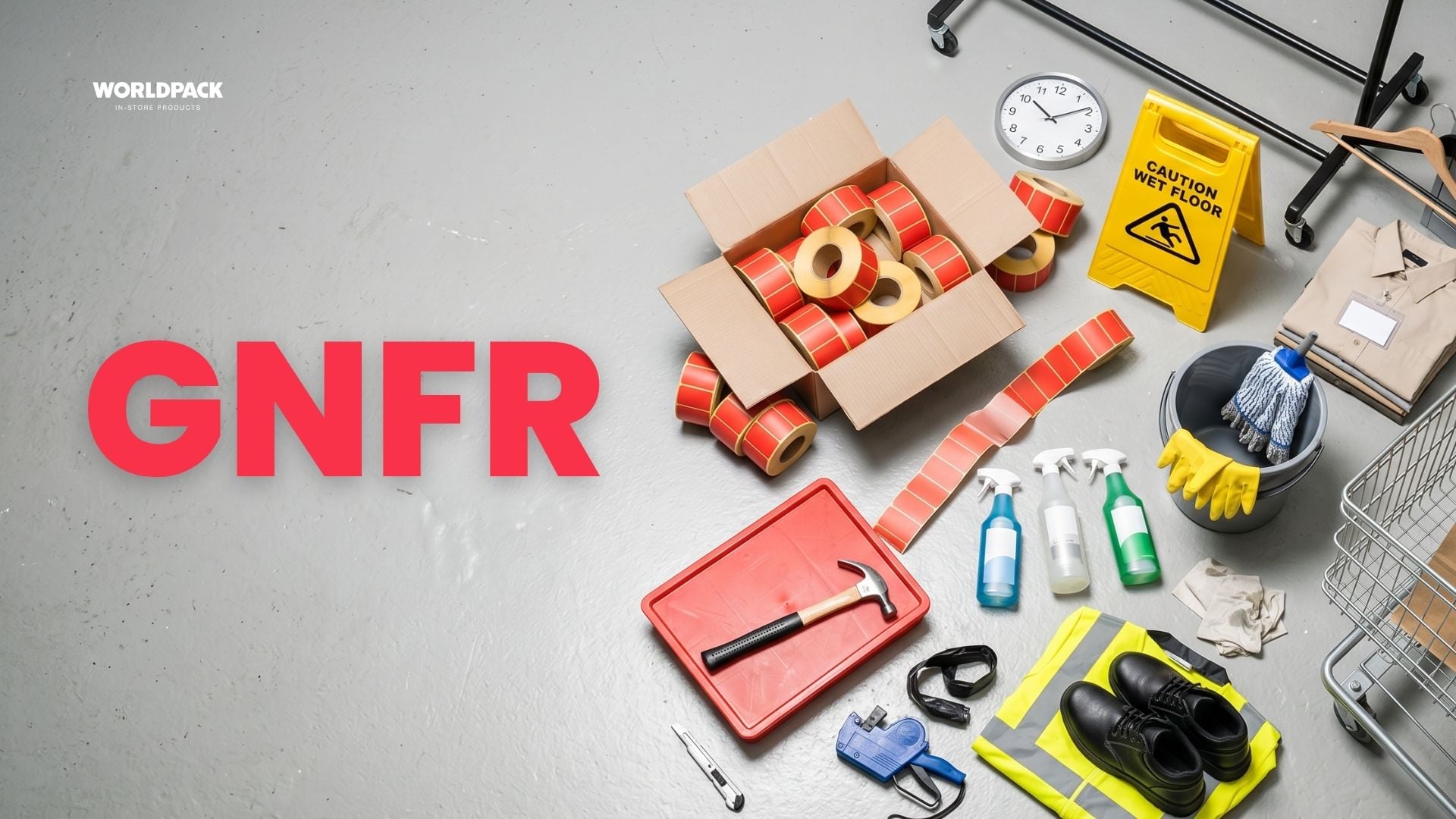

GNFR stands for Goods Not For Resale. It refers to all the products and services a retail business buys to keep its stores and operations running, but never sells to customers: things like packaging, cleaning supplies, store fixtures, or till rolls. It is also commonly called indirect spend or non-merchandise spend.
Most retail teams have a clear grip on what they sell. GNFR is everything else. And in most retail organisations, "everything else" turns out to be a surprisingly large, surprisingly complex, and surprisingly under-managed part of the business.
This article explains what GNFR covers, why it matters more than many retailers realise, and what better management of it actually looks like in practice.
GNFR vs GFR: what is the difference?
GFR (Goods For Resale) is the merchandise a retailer buys to sell to customers. A fashion retailer's GFR is its clothing. A supermarket's GFR is its food. This spend is typically managed by a dedicated buying team with tight controls, supplier contracts, and close margin oversight.
GNFR (Goods Not For Resale) is everything that supports the selling process without being part of it. No customer buys a till roll or a mop. But without them, the store does not function. GNFR spend is essential, and yet it rarely receives the same level of scrutiny as the merchandise it exists to support.
What counts as GNFR? Examples by category
GNFR covers a wide range of product types. The following categories give a practical picture of what falls under the term:
Store environment and fixtures
- Shelving, display systems, and mannequins
- Shopping baskets and trolleys
- Signage, price holders, and fitting room hardware
- Point-of-sale displays and visual merchandising materials
Packaging and logistics
- Shopping bags, carrier bags, and tissue paper
- Transit packaging, stretch film, and tape
- Labels, stickers, and tags
- Void fill, delivery bags, and corrugated boxes
Cleaning and facilities
- Cleaning chemicals and janitorial supplies
- Waste disposal equipment
- Maintenance tools and spare parts
- Facilities management services
IT and technology
- POS systems and handheld scanners
- Till rolls and receipt paper
- Software licences and hardware
- Back-office equipment
Marketing and in-store experience
- Promotional props and campaign materials
- In-store displays and decorative elements
- Print and media solutions
Workwear and staff-facing items
- Uniforms and staff clothing
- Safety gear and personal protective equipment (PPE)
- Name badges and lanyards
If it keeps the store running but is never sold to a shopper, it is probably GNFR.
Why does GNFR matter for retailers?
GNFR commonly represents 20–30% of a retailer's total operational costs. That figure is cited consistently across procurement industry sources and for any retailer operating at scale, it translates into a significant sum of money spread across dozens of categories, hundreds of SKUs, and potentially hundreds of suppliers.
Despite this, GNFR is frequently under-managed and under-scrutinised compared to merchandise spend. Buying teams, budgets, and performance reporting tend to centre on GFR. GNFR, by contrast, is often fragmented across departments, handled by people whose primary job is not procurement, and reviewed only when something goes wrong.
The consequences are predictable. Poorly managed GNFR shows up as empty cleaning product cupboards, broken fixtures that nobody has ordered replacements for, inconsistent store presentation across locations, and an administrative overhead that comes from managing dozens of small suppliers with no central oversight.
Why is GNFR so often overlooked?
The core reason is structural. GNFR spend does not sit neatly in one team or one budget line. Marketing buys its own campaign props. The operations team orders its own cleaning supplies. IT procures its own hardware. Facilities management handles its own maintenance contracts. Each team solves its own problem without anyone seeing the full picture.
Compare this to merchandise procurement, where a single buying team typically owns the entire category, with clear targets, supplier relationships, and performance tracking built in. GNFR has no equivalent centre of gravity in most retail organisations.
The result is what procurement professionals call maverick spend: purchases made outside of any agreed process, often at higher cost, with no visibility at group level. For a retailer with 50 or 100 stores, the cumulative effect is significant, both in direct cost and in the operational inconsistency it creates across the store network.
How can retailers manage GNFR more effectively?
There is no single fix, but the most effective approaches tend to share a few common characteristics:
Consolidate suppliers. Managing 30 suppliers to cover GNFR means 30 order processes, 30 invoices, and 30 relationships to maintain. Reducing that number, ideally to one or a small number of strategic partners, cuts administrative burden and creates the volume needed to negotiate better pricing.
Standardise specifications across stores. When every store manager orders their own version of a cleaning product or a shopping bag, quality and cost vary unpredictably. Agreeing a fixed, approved assortment across the estate brings consistency and removes unnecessary duplication.
Centralise ownership and visibility. Someone needs to own GNFR at a group level. Without a central view of what is being ordered, by whom, and at what cost, there is no basis for improvement. Centralised ordering systems that give store teams access to a pre-approved assortment, while giving HQ full visibility, solve this directly.
Use data to manage demand. Stockouts and overstocking are both costly. Tracking actual usage by store, rather than relying on estimates or reactive ordering, makes forecasting more accurate and reduces both waste and last-minute emergency orders.
At what point should a retailer consider outsourcing GNFR?
Outsourcing GNFR tends to make sense when the number of stores or suppliers has grown to the point where internal management becomes a significant operational overhead. Common signals include inconsistent stock availability across locations, a high volume of emergency or reactive orders, limited visibility of total GNFR spend, and store teams spending time on procurement instead of customers.
Curious what better GNFR management could look like for your own store network? Get in touch with Worldpack and we will walk through it together.
How Worldpack helps retailers manage GNFR
Worldpack acts as a single outsourced GNFR partner for retail chains, consolidating sourcing, inventory management, and delivery of GNFR products so retailers do not have to manage a fragmented supplier base themselves.
The model is built around three stages: sourcing the right products through a global purchasing network backed by Bunzl, consolidating the full GNFR assortment into one system with one point of contact, and delivering directly to individual stores or distribution centres, depending on how each retail organisation operates.
Store teams order through a centralised platform (Brandstore), with each location seeing only its approved assortment and budget. HQ gains full visibility across the estate. Real-time usage data and Power BI reporting make it straightforward to track spend, spot inefficiencies, and adjust the assortment over time.
The practical result is fewer suppliers to manage, less administrative overhead, more consistent stock availability across stores, and a clearer picture of where GNFR spend is going, and where it can be reduced.
Frequently asked questions about GNFR
Is GNFR the same as indirect procurement?
Yes, the terms are used interchangeably in most retail contexts. Indirect spend, non-merchandise spend, and non-product related (NPR) spend all refer to the same category: goods and services purchased to support operations rather than for resale to customers.
What is a typical example of a GNFR product?
Common examples include shopping bags, till rolls, cleaning supplies, hangers, safety equipment, signage, and transit packaging. These are the products every store uses daily but never puts on the shelf for sale.
Why is GNFR harder to manage than merchandise spend?
GNFR covers a wide range of unrelated product categories, involves a large number of suppliers, and is typically spread across multiple departments without central ownership. Each category may require a different sourcing approach, and consumption patterns vary by store size and location. That combination of variety, fragmentation, and lack of visibility makes GNFR structurally more complex to manage than merchandise, even though the individual items are often simpler products.