
TL;DR: Retailers that actively manage GNFR spend can realistically reduce total procurement costs by 15 to 30%. Savings come from four main levers: supplier consolidation, assortment rationalisation, improved spend visibility, and logistics optimisation. The exact figure depends on current maturity, store count, and how fragmented operations are today.
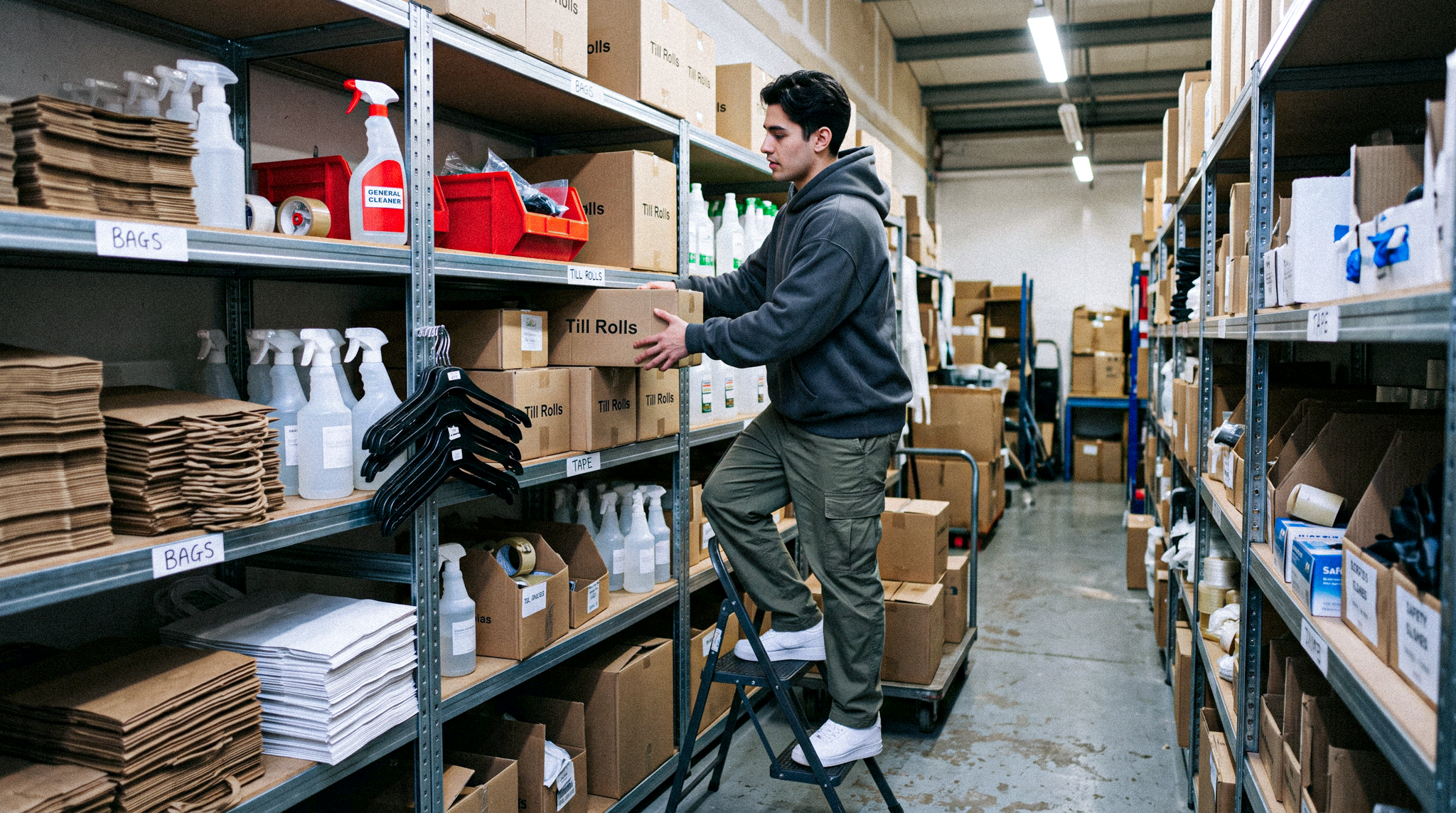
There is a category of spend sitting inside most retail organisations that receives a fraction of the attention it deserves. It is not the merchandise. It is not the marketing budget. It is everything else. The bags at the till. The cleaning products in the stockroom. The safety equipment, the hangers, the till rolls, the tape. The products that keep stores running every single day, and that nobody outside of procurement ever thinks about until they run out.
GNFR. Goods Not For Resale.
For a retailer operating 50 stores, GNFR might involve 30 or 40 suppliers, each with their own order process, invoice cycle, and delivery schedule. Multiply that across 200 stores and multiple countries, and the complexity does not scale linearly. It compounds. More suppliers, more exceptions, more admin, more rogue purchasing decisions made at store level because the approved channel is too slow or too complicated to use.
Most retail organisations know, at some level, that GNFR is inefficient. What they often do not know is how much that inefficiency is costing them. And more importantly, what a realistic improvement looks like when the right controls are in place.
This blog answers both questions.
What Is GNFR and Why Does It Matter for Cost Control?
GNFR stands for Goods Not For Resale. It covers every operational product a retail store uses but does not sell to shoppers. Cleaning chemicals. Hangers. Shopping bags. Labels. Office supplies. Safety gear. Packaging materials. Point-of-sale materials. Workwear. Till rolls.
If it keeps the store running but never reaches the retail floor as sellable inventory, it is almost certainly GNFR.
The scale surprises most people when they see it clearly for the first time. Across procurement industry sources, GNFR commonly represents 20 to 30% of a retailer's total operational costs. For a retailer with £100 million in annual operational expenditure, that is £20 to £30 million spent on products that are largely invisible in strategic planning conversations.
The challenge is not just the size of the spend. It is how that spend behaves. Unlike merchandise, GNFR purchasing tends to be decentralised, reactive, and spread across dozens of categories and suppliers. That combination makes it difficult to control, difficult to benchmark, and expensive to manage.
Where Retailers Are Losing Money on GNFR Right Now
The losses are not dramatic. They rarely show up as a single line item or a single decision. They accumulate across four structural problems that most multi-store retailers share.
Fragmented Supplier Bases
Managing 30 suppliers to cover GNFR means 30 order processes, 30 invoices, and 30 relationships to maintain. Each supplier carries its own lead times, minimum order quantities, payment terms, and service standards. The administrative cost of managing that fragmentation is rarely calculated directly, but it is real. Procurement teams spend time on supplier coordination that could be spent on category strategy. Finance teams process invoice volumes that could be consolidated. And stores deal with inconsistent availability because no single supplier has full responsibility for continuity.
Reactive Ordering Patterns
Ordering every day with a next-day delivery is expensive. It drives up logistics costs, creates erratic demand signals that make forecasting harder, and increases the probability of both stockouts and overstocking. When stores order reactively, based on what they notice is running low, they are not optimising for cost. They are optimising for immediacy. The result is small, frequent orders at higher per-unit and per-delivery costs.
Overstocking and Inventory Inefficiency
Reactive ordering creates a counterintuitive problem: it coexists with overstocking. Because there is no visibility into what each store actually holds, stores order more than they need as a buffer. Capital is tied up in excess inventory. Obsolete stock accumulates. Products expire or become redundant before they are used. For a retailer with hundreds of locations, the aggregate impact of poor inventory management across GNFR categories is significant.
Inefficient Logistics
Scattered deliveries from multiple suppliers to multiple stores drive up transport costs and create operational noise for store teams. Receiving multiple deliveries per week from different suppliers means more time spent handling goods, more administration, and more risk of delivery issues disrupting store operations.
How Much Can Retailers Realistically Save on GNFR?
The honest answer is: it depends. A retailer that already has supplier consolidation in place and a centralised ordering system will find fewer obvious wins than one managing GNFR across 40 suppliers with no spend visibility. But across the industry, the savings potential breaks down into four recognisable areas.
Procurement Cost Reductions: 10 to 20%
Volume consolidation creates pricing leverage that fragmented purchasing simply cannot access. When a single partner manages all GNFR sourcing across a retail network, total purchasing volume increases per category. That scale can be used to negotiate better unit pricing, more favourable payment terms, and priority availability commitments.
Product engineering and specification reviews tend to surface further savings. Many retailers are buying premium-specification products for applications where a more cost-effective alternative would perform equally well. Assortment rationalisation, the process of reducing SKU duplication and aligning specifications to actual store needs, typically delivers an additional 5 to 10% reduction in product costs alone.
Administrative and Labour Cost Reductions: 15 to 25%
This is the savings area that receives the least attention and often delivers the most. Every additional supplier in a GNFR programme adds administrative friction. Invoice processing, purchase order matching, delivery discrepancies, supplier communication. These costs are real but rarely attributed to GNFR.
Centralising GNFR into a single ordering system, where store teams order from an approved assortment through one platform, removes most of this friction. Fewer suppliers mean fewer invoices, fewer exceptions, and fewer hours spent by finance, procurement, and store management teams on administrative tasks that add no value. For a retailer with 100 stores currently managing GNFR across 35 suppliers, moving to a single-partner model can reduce invoice volume by 80% or more.
Logistics Savings: 10 to 20%
Optimising delivery frequency and consolidating shipments produces meaningful cost reductions. The business case is straightforward: fewer, larger deliveries cost less per unit shipped than many small ones. For high-volume regions such as the UK, France, Germany, Spain, and Italy, structured 2-to-3-day lead times replace next-day reactive deliveries. For other regions, 3-to-5-day lead times still provide reliable availability without the cost premium of emergency logistics.
The knock-on effect on store operations is equally significant. Store teams spend less time receiving and processing deliveries. Fewer deliveries from fewer suppliers simplifies the receiving process and reduces the risk of disruption during peak trading periods.
Inventory and Waste Reduction: 5 to 15%
Visibility into stock levels, usage patterns, and ordering behaviour per store makes it possible to maintain appropriate inventory without holding excess. Real-time reporting. Power BI dashboards that show usage per location, spend per category, and ordering trends across the network. These tools allow procurement teams to identify where overordering is occurring, where stock is building unnecessarily, and where usage patterns suggest a specification or quantity adjustment is needed.
The result is less capital tied up in slow-moving GNFR inventory, less waste, and a more accurate forecasting model that reduces the frequency of both stockouts and overstock situations.
The Levers That Drive GNFR Savings
Supplier Consolidation
Reducing the supplier base is the foundational lever. It creates volume, simplifies administration, and makes every other improvement easier to execute. A retailer moving from 40 GNFR suppliers to one or two partners does not just save money on individual product categories. It fundamentally changes the structure of how GNFR is managed, how spend is tracked, and how store teams interact with the ordering process.
Assortment Rationalisation
Many GNFR assortments grow organically over time, accumulating duplicates, obsolete items, and category overlaps that no single person ever approved. A structured review of the assortment, conducted with clear criteria for what each store actually needs, typically reduces SKU count significantly while maintaining or improving product availability. Fewer SKUs means simpler ordering, better demand forecasting, and stronger unit pricing on the items that remain.
Spend Visibility
Savings that cannot be measured cannot be managed. Most retailers managing GNFR across multiple suppliers have a fragmented view of what they are spending, where they are spending it, and how that compares to what was planned. Centralising purchasing into a single system and connecting it to reporting tools provides the visibility needed to identify non-compliance, benchmark spend across locations, and build accurate category budgets.
Compliance Management
Maverick buying. Stores purchasing outside the approved supplier and product list because the approved channel is inconvenient or unavailable. This is one of the most common and least visible sources of GNFR cost leakage. Compliance management means closing the gaps that make rogue purchasing attractive: improving the availability and speed of the approved ordering process, giving stores the products they need within the approved assortment, and making the compliant route easier than the non-compliant one.
Store Budgetary Controls
Giving stores visibility into their GNFR budget and restricting ordering to approved products and quantities puts a structural limit on uncontrolled spend. When store teams can only order what has been approved, in quantities aligned with their usage profile, the cost variability that characterises uncontrolled GNFR programmes decreases significantly.
How Worldpack Helps Retailers Achieve These Savings
We operate as a single GNFR partner for multi-store retailers. One supplier. One assortment. One system. One delivery flow. That structure is not incidental. It is designed specifically to address the fragmentation, complexity, and cost leakage that characterises GNFR in most retail organisations, and to ensure every store has access to the retail essentials it depends on, consistently and without friction.
Store teams order through our Brandstore portal, where each location sees only its approved assortment, budget, and permissions. Headquarters gains full visibility across the network through Power BI dashboards that surface usage patterns, spend per location, and optimisation opportunities. Existing preferred suppliers can be integrated into the model where needed, preserving continuity while standardising the operating model.
As part of Bunzl, one of the world's largest distribution groups with operations across 33 countries, we carry sourcing scale that smaller GNFR providers cannot match. That scale translates into pricing leverage, supply chain resilience, and access to a global supplier network audited against strict quality, sustainability, and ethics standards.
The logistics model adapts to how each retailer actually works. Direct-to-store. Distribution centre flows. Hybrid models for retailers with different requirements across regions. The goal in every case is fewer deliveries, better availability, and less operational noise for store teams.
What a Realistic GNFR Savings Programme Looks Like
Retailers that take a structured approach to GNFR optimisation typically see total cost reductions of 15 to 30% over a 12-to-24-month period. The starting point matters. So does the scale of the network, the current level of fragmentation, and how much compliance leakage exists in the current model.
The savings are not theoretical. They are the direct result of structural changes. Fewer suppliers. A rationalised assortment. Centralised ordering with compliance controls. Visibility into spend and usage across every location. Optimised logistics that reduce delivery frequency without compromising availability.
None of these changes require a retailer to accept less. The objective is not to reduce quality or availability. It is to stop paying for the complexity, duplication, and inefficiency that accumulates when GNFR is treated as an afterthought.
For most retail organisations, that treatment is the norm. The cost of it rarely appears on a single report. It hides in invoice volumes, in logistics costs, in time spent by store managers chasing deliveries, in capital tied up in stock that should never have been ordered in the first place.
The savings are there. They are consistent across retail organisations of different sizes, formats, and geographies. Getting to them is a matter of structure, visibility, and the right partner to hold responsibility for all of it.
If GNFR is something your organisation is ready to address seriously, we'd welcome the conversation.
Frequently Asked Questions
What percentage of operational costs does GNFR typically represent for retailers?
GNFR commonly represents 20 to 30% of a retailer's total operational costs, according to procurement industry sources. For large multi-store retailers, this translates into tens of millions in annual spend spread across dozens of categories and potentially hundreds of suppliers.
How much can a retailer realistically save by optimising GNFR spend?
Retailers that implement structured GNFR management typically achieve total cost reductions of 15 to 30% over a 12-to-24-month period. Procurement cost savings tend to fall in the 10 to 20% range. Administrative and labour savings can reach 15 to 25%, particularly when supplier numbers are reduced significantly. Logistics and inventory improvements add a further 5 to 20% depending on the current state of the operation.
What are the biggest sources of GNFR cost leakage in retail?
The four most common sources are fragmented supplier bases, reactive ordering patterns, inventory overstocking, and inefficient logistics. Each compounds the others. Fragmented suppliers make ordering reactive. Reactive ordering drives up logistics costs and creates inconsistent stock levels. Inconsistent stock levels lead to buffer buying, which increases inventory and waste.
What is supplier consolidation and how does it reduce GNFR costs?
Supplier consolidation is the process of reducing the number of GNFR suppliers and channelling purchasing through fewer, often single, partners. Managing fewer suppliers reduces administrative overhead, creates volume leverage for better pricing, simplifies logistics, and enables stronger compliance management. Moving from 40 GNFR suppliers to one or two can reduce invoice volume by 80% or more while improving overall spend visibility.
What is maverick buying and why does it increase GNFR costs?
Maverick buying refers to purchasing outside approved supplier contracts or ordering processes, typically at store level. It occurs when the approved channel is too slow, too complex, or does not stock the product a store needs. The result is higher unit prices, fragmented spend data, and reduced compliance. Centralised ordering platforms with controlled assortments and budgetary limits are the most effective structural response.
How does spend visibility contribute to GNFR savings?
Without visibility into what each store is ordering, how much it is spending, and how that compares to its usage profile, procurement teams cannot identify where costs are running above target. Real-time reporting tools, such as Power BI dashboards connected to centralised ordering data, surface ordering anomalies, highlight overstocking, and allow procurement to benchmark spend across locations. Visibility turns a reactive spend category into a managed one.
How long does it take to see savings from a GNFR optimisation programme?
The timeline varies depending on the scale of the network and the complexity of the current supplier landscape. Most retailers see meaningful improvements within the first six to twelve months, particularly in administrative costs and logistics. Deeper savings from assortment rationalisation and demand forecasting improvements typically materialise over a 12-to-24-month period.